


Hortus Mortus* is Latin for ‘dead garden.’
People often think that gardens sit opposite from cemeteries. Or that the natural world is more connected to living than it is to dying. I have found over the years that they are one and the same.
More than 15 years ago, I remember pursuing my first real entry into the world of death and dying by way of American funeral service. I remember spending entire days shadowing staff in various funeral homes, cemeteries, crematories, and related places. I was there to learn from those already employed in those jobs, and I was seeing if that might be an environment I wanted to work in and around.
One early morning at a gigantic 100+ acre cemetery, I climbed into an old pickup truck, hand-painted with the cemetery name along the door, and sat next to one of the grounds crew. He had been a cemetery groundskeeper for more than 20 years. I was there to learn about death, and how bodies were buried and organized, but we spent the entire ride through the grounds discussing all of the trees and their quirks. I was there to learn about grave digging, but learned more about the natural spaces that held the graves instead. Lifelong gravediggers saw the trees before the hole, so to speak. They knew how to keep the big old trees happy and cared for, as they made space between their roots for graves that would hold humans nested inside boxes.
As the years went on, I noticed how backyard gardens, forests, botanical gardens, preserves, and the natural world in general, weren’t very opposite from death, dying, grief, and loss at all.
I think that's why after we lose someone or something, we sometimes find ourselves wandering around a park or other green space not really understanding that spending time in nature, the world of the living, is actually taking care of the part of our lives that are dying. Because much of the natural world is dead, or dying, too. So it feels like a mirror, and we can better see ourselves as we are.
I believe that dying and living are more like synonyms rather than antonyms. For each part of us that is growing and changing, there’s a part that is arrested and fading.
There’s another part to Hortus Mortus, and that’s the part that links the dying part of gardening with the living part of the kitchen.
When we harvest fruits and vegetables from our gardens, an ending of sorts, we take that bounty inside to our kitchens, where we make something new. We take the fruits of the soil, now more depleted, and turn that into things that nourish us. We do the same thing with our home apothecaries, too.
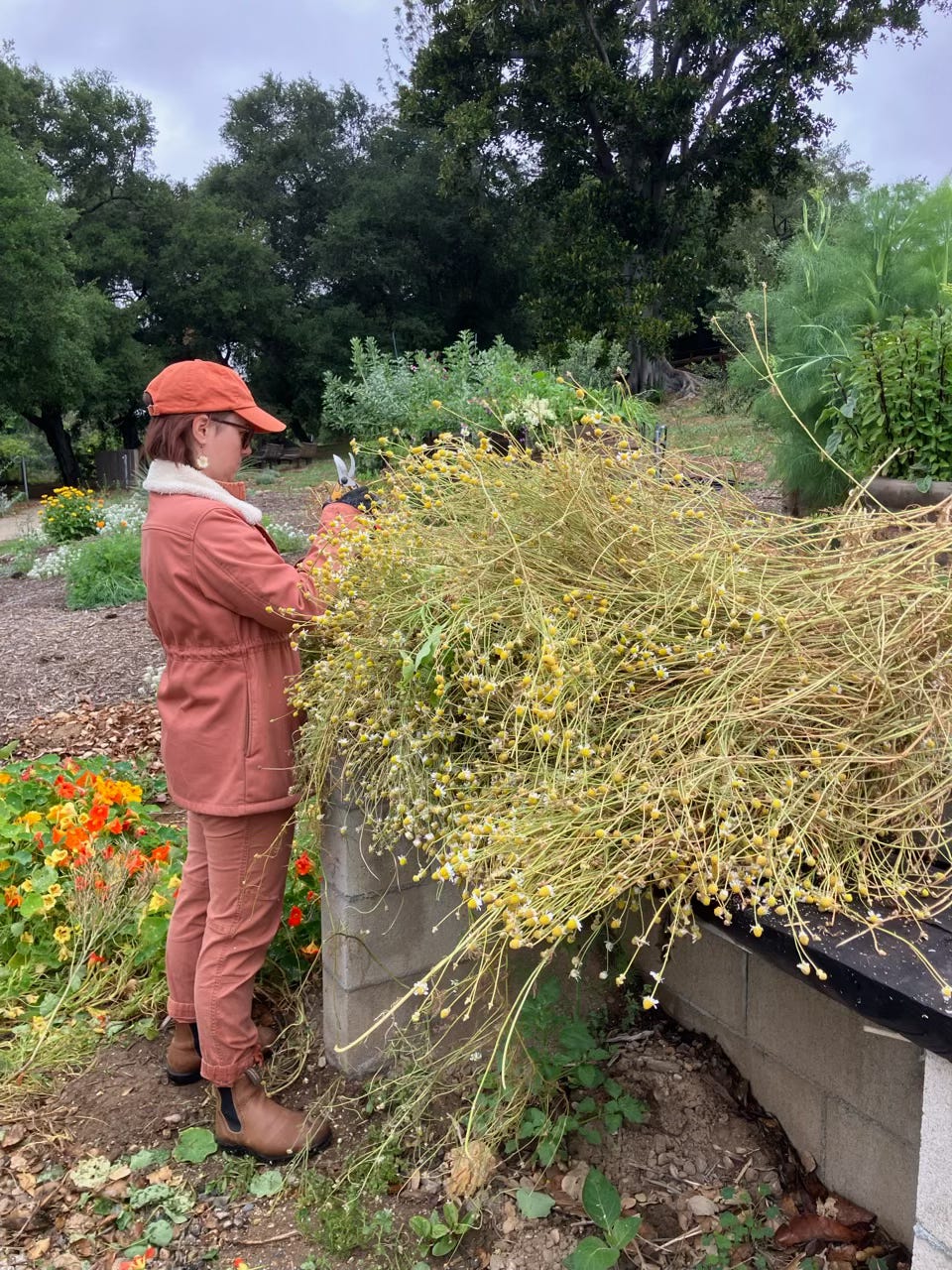
The chamomile for example, all dried up and dead, is ready for harvest. It will be split apart and used in many new ways. Some will be hung up on the wall as a bit of natural art. Some will get steeped in oil for a few months, to later be made into lip balms and salves, and some will be broken down to be used as tea. And something new gets planted where it once grew. The endings are always also beginnings.
As a thanatologist and a horticulturalist, the dead part of gardening is the best part.
The weeding. The deadheading. The harvesting. The soil amending. The stuff that fails to germinate. The part that keeps you on your toes, that begets the most challenges, the stuff that forces you to learn more and not give up—that’s the part that does the most for us.
And that’s a lot like loss itself. The losses are things that happen to us, and the grief is what we do with it. And that’s what I mean when I say Hortus Mortus.
*(Latin aficionados might posit that it should be Hortus Mortuus, with two U’s, and I offer that I favor one U as it mirrors the pattern in the word Hortus, and it’s technically also correct, and such is the way I navigate around my corner of the world. Or, garden. It’s my dead garden, and it’s one U.)